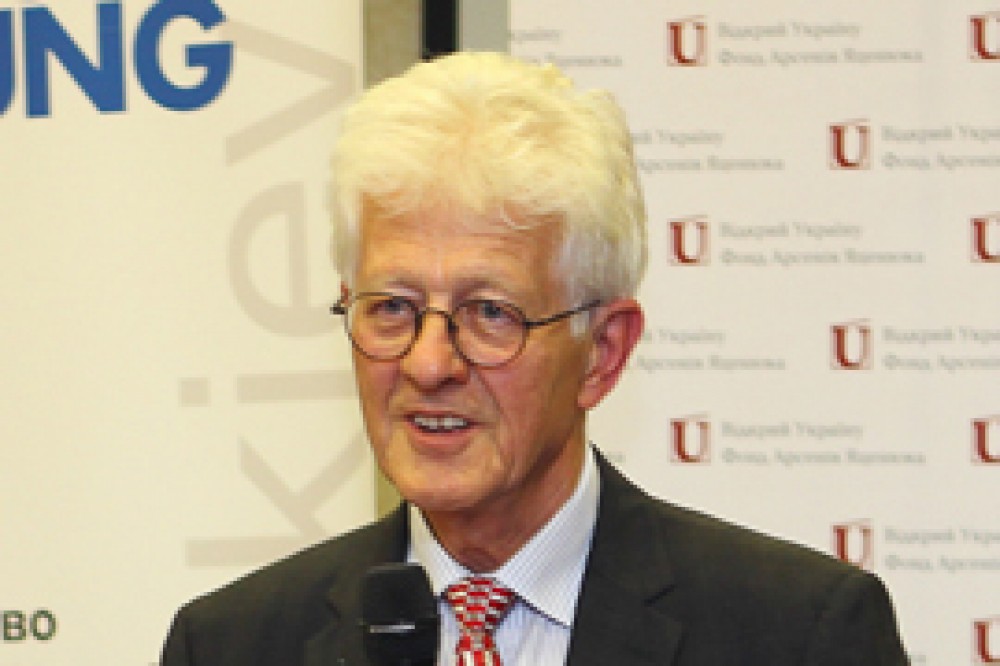
The former Bundestag member mentioned that Russia maintains the principle of geostrategic competition and continuously opposing the West, pointing at the fall of morals in the Western world.
At the same time, Karsten VOIGT pointed out the principal difference between the Ukrainian and Russian nations. In his opinion, the Ukrainian nation is being created through democratic and economic reforms that help build the future. “It is not limited by linguistic, cultural, or ethnic boundaries. In Russia, this is the other way round: the nation is limited by ethnic and linguistic aspects. Thus Putin is questioning the European standards; following his logic, Germany should claim Austria and Switzerland due to the German-speaking population living there”, he said.
In conclusion of his speech, the former President of the NATO Parliamentary Assembly said, that “this crisis strengthens, not weakens the EU and its security policy. The EU is mobilizing its forces”.
REFERENCE INFORMATION:
The Open World Discussion Club is an educational project of Arsenii Yatseniuk’s “Open Ukraine” foundation for socially active youth. Its goal is to bring up a new generation of responsible leaders. Every month, the Foundation arranges lectures by well-known experts, politicians, and community leaders for discussion of the ways for effective solution of social problems in Ukraine and in the world.
Karsten Voigt worked as a coordinator of German–North American Cooperation at the German Ministry of Foreign Affairs from 1999 to 2010, and was a member of the German–American “Atlantic Bridge” (Atlantik-Brücke) organization, an association established to promote dialogue and understanding between Germany and the USA. Mr Voigt studied history, German, and Scandinavian languages and literature at the universities in Hamburg, Copenhagen, and Frankfurt from 1960 to 1969. From 1969 to 1972, he was chairman of the Jusos, organization of Young Socialists in the SPD.
From 1976 to 1998 he was a member of the Bundestag, a member of the foreign affairs and defense committees. Mr Voigt was also a member of the NATO Parliamentary Assembly from 1977 to 1998, chairman of the Defense and Security Committee between 1989 and 1993, Vice President (1992–1994) and President (1994–1996) of the NATO Parliamentary Assembly. Member of the Atlantic Initiative Council, Senior Research Fellow and Member of the Board of the German Council on Foreign Relations (Deutsche Gesellschaft für Auswärtige Politik), member of the Kuratorium (Supervisory Board) of Aspen Institute in Berlin, Kuratorium of Einstein Forum in Potsdam, as well as a member of the International Relations Committee and Turkey Task Group of the board of the Social Democratic Party of Germany. His monograph titled “Religion and Politics. Comparison of the Situation in Germany and the USA” was published in 2007.