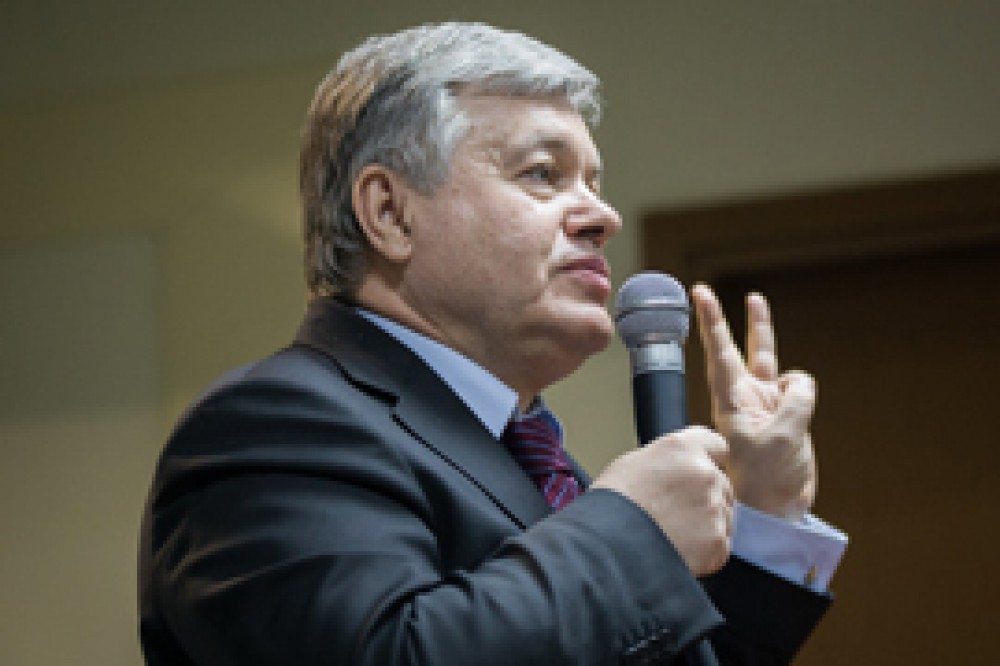
On reasons for recent events in Ukraine: «There are two strategic reasons why it’s happening today in Ukraine – external and internal ones. The external reason is that the Cold War has not yet finished and Ukraine is a final prize in this war.
And the second reason – an internal one – we, as an independent country with such boundaries, exist only for 23 years. One part of the country for a long time belonged to one system of values, and the other part belonged to a totally different one. And the tragedy is that for all these 23 years each part tried to impose its own system of values on another part.
These particular reasons are being used by the external powers. They make plays with our internal controversy. This external factor is decisive for Ukraine and if we cannot manage to deal with it and find a compromise, they have sufficient resources to wage a fight on our territory for long enough.
This war is not our war, but it’s is for Ukraine. Our country can greatly change the balance of geopolitical forces».
On motivation of Volodymyr Putin: «The first version, which I rather tend to support, is that Putin is carrying out a war for geopolitical influence and this is more important to him than Crimea, population of Crimea, or integrity of Ukraine. After 1991 Russia hoped that the West would acknowledge Russia, and they would mutually agree on a certain balance. That did not happen. However as early as in 2008, after the events in Georgia, Russia in fact was recognized as a geopolitical power.
As for now, the maximum assignment for Putin is a border of 1 September 1939. And he is very well aware that he can go only where he has support. The problem of Crimea is not that Russian army entered it, but that significant part of the population is loyal to Russian politics».
On possible scenarios of developments of events in Ukraine: «Now everything is happening in line with very dangerous scenario. Today, this is the first time after the World War II that the annexation of the territory occurred and no one knows the definite prescriptions what to do next. The country is on the verge of war, very difficult economic situation, high demands from the civic society to the government of the country. But Ukrainians are united about the fact that they are not ready to lose Crimea, even if Ukraine will get NATO membership and prospects of EU membership for this. There is a nationwide consensus – none of the political forces is willing to declare publicly that is ready to make sacrifices for peace.
Either we will find a balance of interests and keep the neutrality of Ukraine, at the same time granting to Crimea as much sovereignty as needed. Or we will not find that balance and Russia will take as much as she can.
We lack a clear understanding at the nationwide level what we aspire to ourselves. We need to stop watching as other countries negotiate between each other, we have to formulate what we want.
Today I see two scenarios of development of the events - «Cold peace» and «Cold war».
These two scenarios have a key message – we are ready to go for a truce based on the argument that we do not accept the annexation of Crimea. Meanwhile, we declare that we are not going to escalate any conflict in other spheres, for example in economy.
However the key difference between «Cold peace» and «Cold war» is that if we choose «Cold peace», then the first thing we need to get from Russia is the guarantee that Russia will acknowledge all existing agreements that were effective between us, or it assures us that the military component will not be used against us. At the same time we have to demand from the guarantors of the Budapest Memorandum or from individual countries or from NATO that they should guarantee to us that in the event of aggression against us they will provide military component to us. And this should be clearly written.
If we are in “Cold war” scenario, then no one provides any guarantees to us regarding military component and we find ourselves in a situation when military component may be used against us at any time.
On imposing sanctions: «No one is going to vest into the fight more than we are ready to vest in it ourselves. If we are ready to make a great sacrifice then we can reckon upon sanctions from other countries. However we cannot demand economic sanctions from Europe when we are not willing to introduce them by ourselves. We need to stop thinking what the West will do, but we need to start thinking what we are willing to do».
On Ukraine’s entry into NATO: «Cold peace» scenario requires putting a question of NATO accession into consideration. I believe that the best security for us is a NATO membership, but I understand that it’s not going to happen. Because Ukraine is at the heart of the conflict. And that’s why we need to achieve security by other instruments. The only thing that is available now it is our declaration of “Cold peace” that will become a guarantee of security based on bilateral relations. This is a sample of Taiwan, Japan and South Korea. I cannot see the mere NATO membership.
We are all radical until we bear responsibility. When we come to the front, the whole spectrum starts pushing us, and we start thinking about all parties of a conflict. The right position is when unstable situation does not continue to create new destabilizing factors».
Prospects for next three months: «I can give an accurate forecast that within next three months no Russian military component will enter the territory of Ukraine. However if we do not look for a compromise, Russia will do everything to knock down our economy. Every wallet is going to feel this war.
The government has already announced about reduction of all social expenses. You can cut everything, but if we cut subsidies to miners, we may expect great consequences. At the same time Russia promises that pensions in Crimea will be increased by 2.5 times. That’s exactly why we need a dialogue with the society».
About the authoritarian law: «The first law of authoritarian rule – it’s easy to come to it, but not easy to leave it. And the more authoritarian is the power, the bigger is the problem of peaceful way out».
FOR INFORMATION:
«Open World» Discussion Club is an educational project of Arseniy Yatsenyuk Open Ukraine Foundation for socially active young people. The purpose of the project is to educate new generation of responsible leaders. Each month the Foundation initiates lectures with renowned experts, political and public figures for discussing efficient solutions to social problems in Ukraine and the world.
Oleksnadr CHALY – Ambassador Extraordinary and Plenipotentiary of Ukraine. Honoured lawyer of Ukraine, Juris Doctor. The President of Grant Thornton Ukraine. Member of top-level international commission “Euro-Atlantic Security Initiative”, member of Supervisory Board of United World International Fund and co-chairman of Working group of National Convention on the EU in Ukraine.
From 1993 to 2008 he worked at diplomatic service. Was the head of Treaty and Law Department at the Ministry of Foreign Affairs of Ukraine, a member of Ukraine’s Delegation on negotiations with Russia and Romania with regard to concluding basic political agreements. Later Mr.Chaly was appointed the Ambassador Extraordinary and Plenipotentiary of Ukraine to Romania.
From 1998 to 2004 he was the First Vice Minister of Foreign Affairs of Ukraine and the State Secretary of the Ministry of Foreign Affairs of Ukraine responsible for integration into the EU. In 2006-2008 he worked as the Deputy Head of Presidential Secretariat of Ukraine in charge of foreign policy and as the Foreign Policy Counsellor to the President of Ukraine. Since January 1, 2012 – President of Grant Thornton Ukraine.